
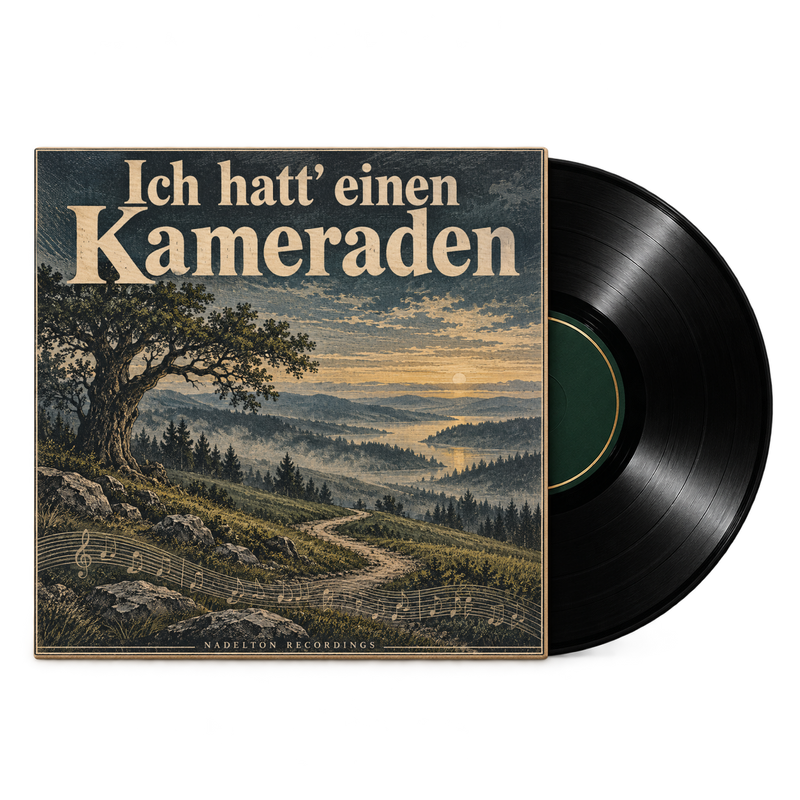
Collection entry
Ich hatt’ einen Kameraden
Nineteen supplied titles connect mourning and military ceremony with Nazi organizations and leaders. Older repertory acquired changing commemorative uses alongside explicitly political songs; the collection’s title does not establish when the recordings were made.
Language not yet verified
19 tracks · About 55 minutes
Download only · No physical CD
Audio language and vocal or instrumental content have not yet been verified.
Listen before you buy
Ich Hatt Eienen Kameraden
$9.99
Digital record download
Download details
MP3 recordings in one ZIP download (about 102.2 MB). Download only · No physical record or CD.
Tracklists, historical notes and sources are available on this website.
The recordings
Ich Hatt Eienen Kameraden2:54
Historical Context
Silcher’s setting of Ludwig Uhland’s lament became part of changing cultures of military remembrance. A museum account describes how the Tübingen Silcher monument erected in 1941 emphasized Ich hatt’ einen Kameraden through surrounding soldier figures, showing how a song could be reframed by its commemorative setting.
A lament in changing ceremonies
The Bundestag’s programme for 18 November 2012 lists Ich hatt’ einen Kameraden as a solo-trumpet item in the national remembrance ceremony. The occasion’s history is not politically continuous: in 1934 the Nazi regime converted Volkstrauertag into Heldengedenktag, organised by the Wehrmacht and NSDAP under the propaganda minister’s direction. After the war, the Volksbund reintroduced Volkstrauertag, with a Bundestag commemoration in 1950, and describes its purpose in terms of mourning, reconciliation and peace. These changing settings show why a familiar lament needs its occasion, as well as its title, to be understood.
Recording details
The 1941 reference dates a monument, not the song or this performance. The supplied spelling is preserved, and the museum object does not identify this recording’s ensemble, occasion or version. The 2012 programme documents a separate announced use; it does not identify this supplied recording or its performers.
Sources & Resources
The German museum description was checked in indexed text; full-page access remains unverified.
Museumsverband des Landes Brandenburg: Friedrich Silcher, object from Kreismuseum Finsterwalde
Deutscher Bundestag: Hasselfeldt hält Gedenkrede zum Volkstrauertag
Volksbund Deutsche Kriegsgräberfürsorge: Geschichte des Volkstrauertages
- Volks Ans Gewehr2:46
- Regiments Gruss2:10
Zapfenstriech Marsch2:13
Historical Context
The ceremonial Großer Zapfenstreich grew from earlier evening signals. The Bundeswehr’s history credits Wilhelm Wieprecht with the later musical arrangement first performed in Berlin on 12 May 1838. This layered history distinguishes a complete ceremony from any single march carrying a related title.
Recording details
The abbreviated supplied title does not prove that the complete ceremony, its 1838 arrangement or any particular component is recorded here. No modern ensemble or ceremonial occasion is assigned.
Sources & Resources
- Prinz Eugen Marsch2:00
Leibstandarten Marsch Adolf Hitler2:34
Historical Context
The unit invoked in this title also had a documented role in political persecution. The US Holocaust Memorial Museum records that the Leibstandarte supplied guards at Columbia-Haus until the turn of 1934–1935, where political prisoners were detained, abused and murdered. This context belongs beside its ceremonial musical image.
Recording details
The unit name in a title is not proof that its band performed this file. No musician’s membership, beliefs, recording date or connection with the camp is inferred from the supplied recording label.
Sources & Resources
- Nur Der Freiheit3:06
- Als Die Goldne Abendsonne2:44
- Lore, Lore3:32
- Ergerlander Marsch2:40
Horst Wessel Lied 13:11
Historical Context
The Horst-Wessel-Lied grew from a poem published in the Nazi newspaper Der Angriff in 1929. After Wessel’s death in 1930, Goebbels promoted a manufactured martyr image around him. The song’s historical significance lies in this organized propaganda and political mobilization, not simply in its melody.
Recording details
The suffix 1 is a supplied file label, not an established version number. This account does not authenticate the text, singer, ensemble, occasion or date heard in the audio.
Legion Condor3:12
Historical Context
The Legion Condor supported Franco’s forces during the Spanish Civil War. Its bombing of Guernica on 26 April 1937 and the propaganda surrounding its public image place this title within a history of intervention and violence against civilians, rather than a self-contained tradition of military spectacle.
Recording details
The title provides a historical research connection, not evidence of a Legion Condor performance, commission or original carrier. No particular musicians’ affiliation is inferred.
- Prasentiermarsch1:48
- Klar Zum Gefecht2:26
- Pariser Einzugmarsch4:02
- Der Fuhrer Ruft2:27
Badenweiler Marsch2:50
Historical Context
Badenweiler illustrates why a familiar march title needs comparison with the music. The Library of Congress finding aid lists a Fürst Badenweiler-Marsch-Lied / Badonviller entry and a separate Badenweiler item under Heinz Krostewitz. These distinct catalogue leads help keep similarly named works and editions apart.
Recording details
Neither entry is assigned as this track’s composer or arrangement. The finding aid describes printed collection holdings, not the provenance, performers or rights of the supplied audio.
Sources & Resources
Prior finding-aid text evidence is retained. A fresh fetch returned HTTP 403; the cited page images were not inspected.
Library of Congress: German National Music Collection finding aid
- Rot Scheine Die Sonne 14:06
- Es Ist So Schon Soldat Zu Sein3:57
Behind the sound
Commemoration, political martyrdom and wartime violence
The likely comparison for the opening title is Silcher’s setting of Uhland’s Ich hatt’ einen Kameraden. A museum account explains how the soldiers’ lament was foregrounded in the 1941 Silcher memorial at Tübingen. Military ceremony has its own chronology: the Bundeswehr dates Wieprecht’s musical presentation of the Großer Zapfenstreich to 1838. Neither history establishes a funeral recording, memorial performance or complete ceremony in these files.
Leibstandarten Marsch Adolf Hitler invokes Hitler’s SS bodyguard formation. The Holocaust Memorial Museum documents Leibstandarte guards at Columbia-Haus, where political detainees suffered abuse. Horst Wessel’s name carries another propaganda history: the German Historical Museum describes his poem’s 1929 publication and Goebbels’s campaign after his death in 1930. Institutional dedications and political martyrdom require this context without establishing who made the supplied recordings.
The Legion Condor supported Franco’s forces against the Spanish Republic. The German Historical Museum places the bombing of Guernica on 26 April 1937 and civilian suffering alongside the Nazi propaganda that promoted the unit’s image. These consequences belong beside the collection’s military titles. The supplied Legion Condor wording does not identify a specific musical work, air unit, performance or date.
Presented for critical historical study of commemorative music, propaganda and dictatorship, including abused political detainees and civilians harmed in Spain. Nazi and fascist ideology and violence are not endorsed.