
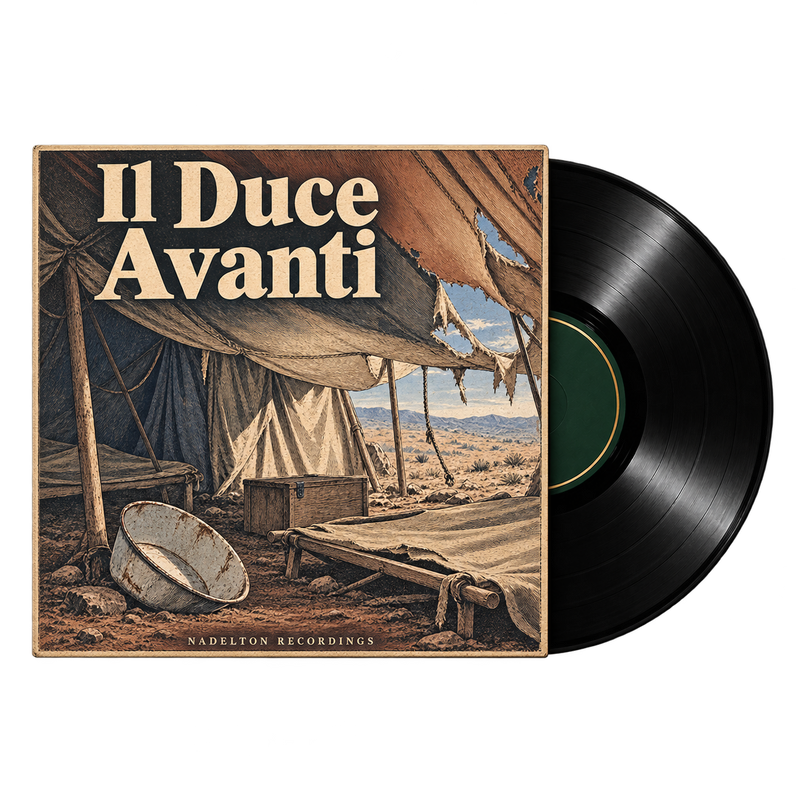
Collection entry
Il Duce Avanti
Twenty-four supplied titles connect national identity, military mobilization and colonial expansion, alongside two dated speech labels. Their historical setting includes the invasion and occupation of Ethiopia; the identities of the recordings remain unresolved.
Language not yet verified
24 tracks · About 62 minutes
Download only · No physical CD
Audio language and vocal or instrumental content have not yet been verified.
Listen before you buy
Giovinezza
$9.99
Digital record download
Download details
MP3 recordings in one ZIP download (about 116.4 MB). Download only · No physical record or CD.
Tracklists, historical notes and sources are available on this website.
For personal, noncommercial use. Please do not resell or share downloads. Download use terms
The recordings
Mussolini speech October 2, 19352:06
Historical Context
The label points to the mobilization address of 2 October 1935, before Italy invaded Ethiopia the following day. ICRC research documents attacks on protected medical facilities during the campaign, placing human suffering beside the regime’s rhetoric.
Recording details
The filename does not authenticate the speaker or excerpt. REDIRE’s separate DS 003 record carries a 1937 issue date, distinct from the 1935 event.
Sources & Resources
ICRC article: checked through indexed text; the full page was not retrieved in this review.
University of Bonn, REDIRE: Discorso del 2 Ottobre 1935-XIII
Giovinezza3:23
Historical Context
Turin’s archive traces Giovinezza to the 1909 student song Il Commiato by Giuseppe Blanc and Nino Oxilia. Military and Fascist rewritings changed its political meaning, so the title encompasses more than one text tradition.
Recording details
The BnF separately catalogues a Blanc/Gotta party-anthem score. Neither that score nor the title identifies this file’s text, arrangement or performance.
- All Armi2:44
- Il Canto Del Volontari D' Africa2:27
- Figli Della Italiane2:21
- Marcia Della Legioni3:54
Inno A Roma3:23
Historical Context
Puccini’s catalogue dates Inno a Roma to late March 1919 and its first performance in Rome to 1 June. The work’s earlier history shows why a later compilation’s political framing cannot date every composition.
Recording details
The work comparison does not establish this recording’s composer, performers, arrangement or date.
A Tripoli1:20
Historical Context
Librinlinea describes A Tripoli! as a patriotic song-march by Colombino Arona with words by Giovanni Corvetto. Its score’s cover records distribution to troops in Tripoli, connecting the work with earlier colonial mobilization.
Recording details
The indexed score description dates publication as after 1911. This comparison does not authenticate the work, arrangement or date of the supplied recording.
Sources & Resources
Librinlinea score catalogue: checked through indexed text; the full page was not retrieved in this review.
Librinlinea: A Tripoli! score, LO11430765
- Adua2:27
- Africa Nostra3:03
- In Africa Si Va2:28
- Battaglioni M2:28
- Africanella2:33
- O Morettina3:05
- C'era Una Volta Il Negus2:56
- Povero Selassie4:36
- Ti Saluto E Vado in Abessinia2:36
- Il Passo Della Corsa1:17
Faccetta Nera1:51
Historical Context
REDIRE examines Faccetta nera as propaganda surrounding the Ethiopian war, built around racial hierarchy, sexual domination and the presentation of conquest as liberation. Its popularity belongs to the history of colonial power and its victims.
Recording details
The separate Odeon catalogue entry does not establish this file’s version, performers, language or recording date.
- La Bandiera Tricolore2:19
- Il Rittorno Del Legionario2:05
- Cantate Del Legionari2:32
Mussolini speech May 5, 19361:44
Historical Context
Luce distinguishes the 5 May 1936 announcement of Italian troops entering Addis Ababa from the empire proclamation four days later. The earlier date belongs to the supplied label. Museo delle Civiltà documents colonial occupation continuing from 1936 to 1941.
Recording details
The Luce catalogue supplies event context only. No match to its soundtrack, speaker, excerpt or source medium has been established.
Sources & Resources
Luce film catalogue: checked through indexed text; the full page was not retrieved in this review.
Istituto Luce: the separate 5 and 9 May 1936 addresses
Museo delle Civiltà: Seated emperor with four standing men flanking him
- Marcia Su Roma2:12
Behind the sound
Colonial mobilization and the language of empire
The opening speech label points to Mussolini’s mobilization address of 2 October 1935. Italy invaded Ethiopia the following day. ICRC archive research documents mustard-gas warfare and repeated attacks on medical facilities during the campaign. These harms belong alongside the collection’s colonial vocabulary. The filename remains a claim about a speech, without authenticating its speaker, excerpt or recording.
Istituto Luce distinguishes the 5 May 1936 announcement of Italian troops entering Addis Ababa from the proclamation of empire on 9 May. The supplied May speech label gives the earlier date. Occupation continued beyond those ceremonies: Museo delle Civiltà documents the 1936–1941 occupation and the removal of an Ethiopian parliamentary painting to Italy. Neither event history identifies the supplied audio.
Songs carried changing political meanings. Turin’s university archive traces Giovinezza from the 1909 student song Il Commiato through military and Fascist adaptations. Bonn’s REDIRE project examines Faccetta nera as colonial propaganda built around racial hierarchy, sexual domination and the portrayal of conquest as liberation. These histories frame the supplied titles without establishing their text versions, arrangements, performers or recording dates.
Presented for critical historical study. Fascist dictatorship, colonial violence, racism and sexual domination are not endorsed.