
Collection entry
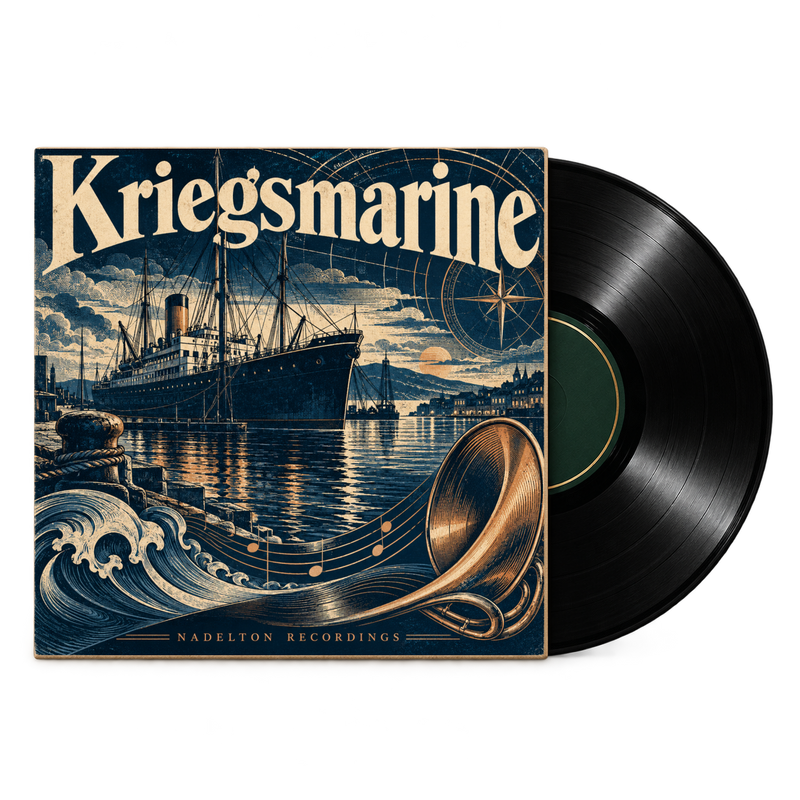
Kriegsmarine
Twenty-five catalogue entries carry titles associated with naval life, martial song and wartime propaganda. Their historical setting includes both older repertory and Nazi uses of music; performers and recording dates remain unverified.
Language not yet verified
25 tracks · About 70 minutes
Download only · No physical CD
Audio language and vocal or instrumental content have not yet been verified.
Listen before you buy
Wir Fahren Gegen Engelland (1)
$9.99
Digital record download
Download details
MP3 recordings in one ZIP download (about 128.5 MB). Download only · No physical record or CD.
Tracklists, historical notes and sources are available on this website.
For personal, noncommercial use. Please do not resell or share downloads. Download use terms
The recordings
Wir Fahren Gegen Engelland (1)3:24
Historical Context
The German Historical Museum traces the Engellandlied to Hermann Löns’s 1910 Matrosenlied and Herms Niel’s 1939 setting. Its postcard from about 1940 shows how an older text was recruited into Nazi propaganda for an invasion of Britain.
Recording details
The documented work history does not establish which setting or performance the numbered supplied title represents.
Sources & Resources
Institutional object-page text inspected on 15 October 2026; the postcard image was not reproduced or used to identify audio.
- Flieg, Deutsche Fahne, Flieg3:35
- Heut' Geht Es An Bord3:05
- Seemanns Los2:59
- Warte Mein Mädel3:11
- Windstärke 123:13
- Kameraden Aus See3:01
- Mit Vollen Segeln2:55
- Heut' Stechen Wir Ins Blaue Meer2:19
- Wo Matrosen Sind2:54
- Michel, Horch Der Seewind Pfeit3:03
Altniederländishes Dankgebet3:04
Historical Context
The Bavarian State Library catalogues a 1915 edition of Max Reger’s setting of the Dutch thanksgiving hymn. A Nazi programme dated 29 March 1938 prescribed the hymn after Hitler’s speech at the planned 9 April Vienna rally, showing older sacred repertory being appropriated for political ceremony.
Recording details
The DDB catalogue dates the separate Kremser disc with the literal notation ‘c 1928’, without the prefix being interpreted here. Reger’s score, that disc and the programme are distinct documents; the programme records an instruction, not proof of a performance.
Sources & Resources
Title inspected; composer, publisher and 1915 date checked in indexed institutional metadata on 15 October 2026. Full catalogue fields and score images were not directly inspected. Institutional catalogue text inspected on 15 October 2026. Separate object only; no comparison audio was played or matched. PDF text inspected on 15 October 2026; relevant page images could not be inspected. This is programme evidence, not supplied-audio identification.
- Willst Du Deutscher Sein2:35
Admiral Stosch-Marsch2:54
Historical Context
The Deutsches Museum catalogues Carl Latann’s Admiral Stosch-Marsch on a Hupfeld Animatic player-piano roll. This mechanical-music object shows the march circulating through a medium quite different from a live naval band.
Recording details
The museum’s composer, manufacturer and roll-format information describes its own object; it does not identify the medium, arrangement or performers in this file.
Sources & Resources
Institutional indexed catalogue text checked on 15 October 2026; full object page and roll images not directly inspected.
Deutsches Museum: Admiral Stosch-Marsch, Hupfeld Animatic roll
- Wir Ziehen Nach Engelland2:42
- U-Boot Lied2:34
- Torpedo Los !2:47
Zuruckkommen Exposé Lt. Günther Prien Aus U-471:43
Historical Context
After U-47 sank HMS Royal Oak at Scapa Flow on 14 October 1939, Nazi publicity turned its commander Günther Prien into a celebrated war hero. The German Historical Museum’s postcard documents that image-making; the Royal Navy records the attack’s eventual toll of 835 lives.
Recording details
The supplied speech-like label does not authenticate Prien’s voice, a broadcast, an excerpt or a recording date.
Sources & Resources
Institutional object-page text inspected on 15 October 2026; historical context only. Official Royal Navy article inspected on 15 October 2026; historical event and loss of life only.
Deutsches Historisches Museum: Günther Prien, 1939
U-47 Lied2:33
Historical Context
U-47’s attack on HMS Royal Oak became a Nazi propaganda success as well as a naval event. A contemporary postcard promoted Günther Prien’s heroic image, while the Royal Navy’s remembrance records 835 deaths. Those losses belong beside celebratory representations of the submarine.
Recording details
The title does not select a particular U-47 song, text, arrangement or wartime performance.
Sources & Resources
Institutional object-page text inspected on 15 October 2026; historical context only. Official Royal Navy article inspected on 15 October 2026; historical event and loss of life only.
Deutsches Historisches Museum: Günther Prien, 1939
- Hüte Dich, Engelland2:16
- Ritter Der Nordsee - Schnellboot3:01
- Unsere Minensucher3:02
- Panzerschiffe Deutschland2:20
- Das Muß Den Ersten Seelord Doch Erschüttern1:36
Denn Wir Fahren Gegen Engelland3:15
Historical Context
Josepha von Koskull’s recollection, preserved by the German Historical Museum, links the Engelland song with radio special announcements. She describes her companion’s hostile response, showing that propaganda’s intended message and a listener’s reaction could diverge.
Recording details
This is one person’s retrospective account, not evidence of every listener’s reaction. It does not identify this recording or make it the same performance as track 1.
Sources & Resources
Institutional transcription inspected on 15 October 2026; underlying manuscript not inspected. Institutional object-page text inspected on 15 October 2026; the postcard image was not reproduced or used to identify audio.
Deutsches Historisches Museum: Josepha von Koskull: Kriegsalltag und Kriegspropaganda
Behind the sound
Naval song, propaganda and human loss
During the Second World War, Germany’s navy sought to disrupt the overseas shipping on which Britain depended. Submarines and surface raiders inflicted serious losses, but failed to cut Britain off from its supply routes. This history frames the naval titles while leaving each recording’s date, musicians and relationship to wartime publicity unresolved.
Nazi publicity promoted Günther Prien after U-47 sank HMS Royal Oak at Scapa Flow in October 1939. The Deutsches Historisches Museum documents that hero-making through a contemporary postcard. The attack ultimately cost 835 lives. That human loss is essential beside the Prien and U-47 titles; a filename cannot authenticate a speech or date a performance.
Older music could be appropriated for political purposes. The Bavarian State Library records a 1915 edition of Max Reger’s setting of the hymn associated with the Altniederländisches Dankgebet title. A Nazi programme dated 29 March 1938 prescribed the hymn after Hitler’s speech at the planned 9 April Vienna rally. These separate documents illuminate the repertory’s changing uses without identifying the supplied arrangement or establishing that the planned performance occurred.
Presented for critical historical study. Nazi ideology, persecution and violence are not endorsed.